
If you’ve been following Microsoft’s AI story over the last few months and especially if you have attended any of Microsoft’s city hopping AI Tours, you’ll have noticed a subtle but important shift in their messaging.
😁 Yes, Copilot is everywhere.
😁 Yes, agents are becoming a core part of the narrative.
😁 Microsoft 365 Copilot is not a product play, it is about platform strength.
But underneath that messaging, Microsoft is spending far more time talking about how context if the real differentiator and how it’s more important than AI models on their own. For AI to be truly successful in an Enterprise it’s important it can understand how work actually happens inside an organisation.
One term that keeps surfacing in that conversation is Microsoft Work IQ.
It’s not something you can deploy.
It’s not a licence you can assign.
And it’s not a feature users will ever toggle on or off.
It is, however, one of the most important aspects of Microsoft’s AI story and what differentiates Microsoft from the other players.
What is Microsoft Work IQ?
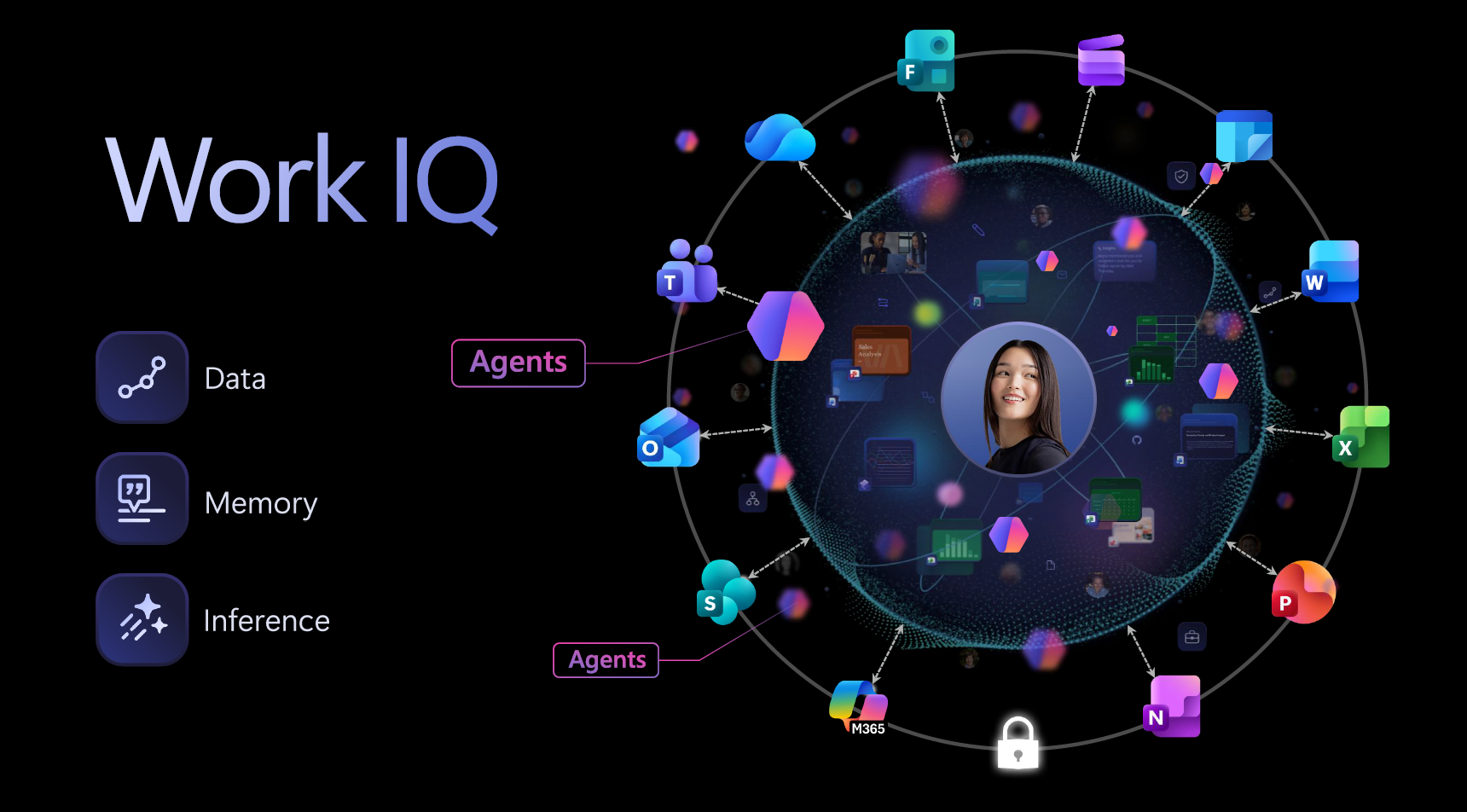
At its simplest level, Microsoft Work IQ is the name given to the intelligence layer that sits behind Microsoft 365 Copilot, designed to understand work context rather than just surface content. It helps the other Microsoft 365 apps and in particular Copilot to understand:
- you,
- your role,
- your teams,
- the apps and data you use,
- how collaboration works in your organisation,
- and what “normal” looks like day‑to‑day.
This goes beyond just access to files and meetings (other AI tools can plug-in and do that). Work IQ connects the dots between emails, chats, documents, relationships, and patterns of work – at scale, and across your organisation.
Work IQ is how Copilot moves from being a prompt‑driven assistant (with access to some data) to something that feels genuinely useful in the flow of work because it understands you, your organisation and your work.
Is Work IQ just another name for Microsoft Graph
It’s easy to see why people think that. On the surface Work IQ may seem like a friendly name for the Microsoft Graph – they serve very different purposes, but Work IQ could not exist without it!
- Microsoft Graph is the secure data layer. It connects Copilot to emails, files, meetings and chats, enforcing permissions and compliance.
- Work IQ sits on top of that data and adds intelligence.
Microsoft describes Work IQ as bringing together three core elements:
- Data – understanding what exists across Microsoft 365.
- Memory – learning patterns, preferences, relationships and your preferences.
- Inference – connecting those signals to predict what matters next.
Microsoft Graph provides the information. Work IQ understands the context.
Microsoft 365: the “Bootstrap” layer for Enterprise AI
One strapline sentence I have heard many times since the London AI tour that I think is really resonating is:
Microsoft 365 isn’t just a productivity suite – it’s the bootstrap layer for enterprise AI.
That phrasing matters here, because what Microsoft is really saying is that Microsoft 365 already is (for most) the environment where work already happens. Emails, documents, apps, meetings, chats and calendars don’t just store information – they capture the context of how people, teams and the organisation operate day to day.
This is exactly what Work IQ is designed to take advantage of – by connecting data, memory and inference, Work IQ doesn’t just help Copilot access information – it helps it understand how work actually flows across teams and roles.
As such Microsoft 365 becomes far more than just a set of apps and enterprise data, it becomes the starting point – the bootstrap – for enterprise AI.
Because when Copilot and agents can reason over:
- your emails and conversations,
- your documents and shared artefacts,
- your meetings and decisions,
- and the relationships between all of them,
they stop being generic AI tools (even generic AI tools that can connect to your data), they start behaving like systems that understand the organisation they’re operating in.
This is where Microsoft believes they have a defensible advantage – Other AI platforms can offer powerful models. Some can connect to enterprise systems. But very few sit natively inside the environment where organisational knowledge already lives, governed by existing identity, governance, security permissions and compliance controls.
Microsoft is betting that this depth of embedded work context – surfaced through Work IQ – is the moat that will make Copilot and agents genuinely useful at scale, not just impressive in demos.
Microsoft’s London AI Tour
At the London AI Tour in Feb 2026, Microsoft drove this message hard.
- Copilot is becoming the interface for work.
- Microsoft 365 is becoming the knowledge substrate for agentic AI.
- The differentiator between consumer AI and enterprise AI is grounding – both in data and in people and teams.
Microsoft talked repeatedly about how Enterprise AI needs (to be useful) be able to understand:
- people and relationships,
- organisational structure,
- permissions and governance,
- and how work actually flows across teams.
That grounding layer is what Work IQ provides.
While Work IQ wasn’t always name‑checked explicitly on stage, the concepts behind it were fundamental to Microsoft’s positioning of Copilot and agents as enterprise‑ready, trusted tools.
From Chatbot to Agentic Workflows
One of the strongest themes from the AI Tour London was that Copilot is no longer being framed as a chatbot – it has moved so far beyond that.
Microsoft is positioning Copilot – and Agent Mode inside apps like Word, Excel and PowerPoint – as something users can ask to act, not just respond. That includes analysing, drafting, coordinating and orchestrating work across tools.
That transition only works if the AI understands context.
Without Work IQ:
- you have to tell it everything (each time)
- agents are reactive,
- responses are generic,
- productivity gains are limited.
With it:
- Copilot understands intent,
- Copilot knows you, your team and your role,
- Copilot agents can act appropriately,
- AI feels aligned to how the organisation actually operates.
Which is how Microsoft is positioning the future of work!
Work IQ matters more than just AI features
The most interesting thing about Work IQ isn’t what it does – it’s what it enables.
Microsoft is effectively saying that enterprise AI value doesn’t come from models alone, or even from Copilot as a surface.
It comes from:
- rich organisational context,
- strong governance boundaries,
- and AI that understands how work actually happens.
Work IQ operates entirely within Microsoft 365’s security and compliance framework, respecting permissions and sensitivity while building intelligence from everyday activity.
That’s what allows Microsoft to confidently push Copilot and agents deeper into the fabric of work.
Final Thought
No user will (likely) never ask for Work IQ.
Most (non-technical) users won’t know what it is or that it even exists.
But they’ll absolutely notice when Copilot starts behaving like it understands them. How it understands who they are, their role, their team, their boss, what they like, their priorities, and how work really gets done in their organisation.
Microsoft’s stance is that Work IQ isn’t a side concept – it’s what makes Enterprise AI work!


Leave a Reply