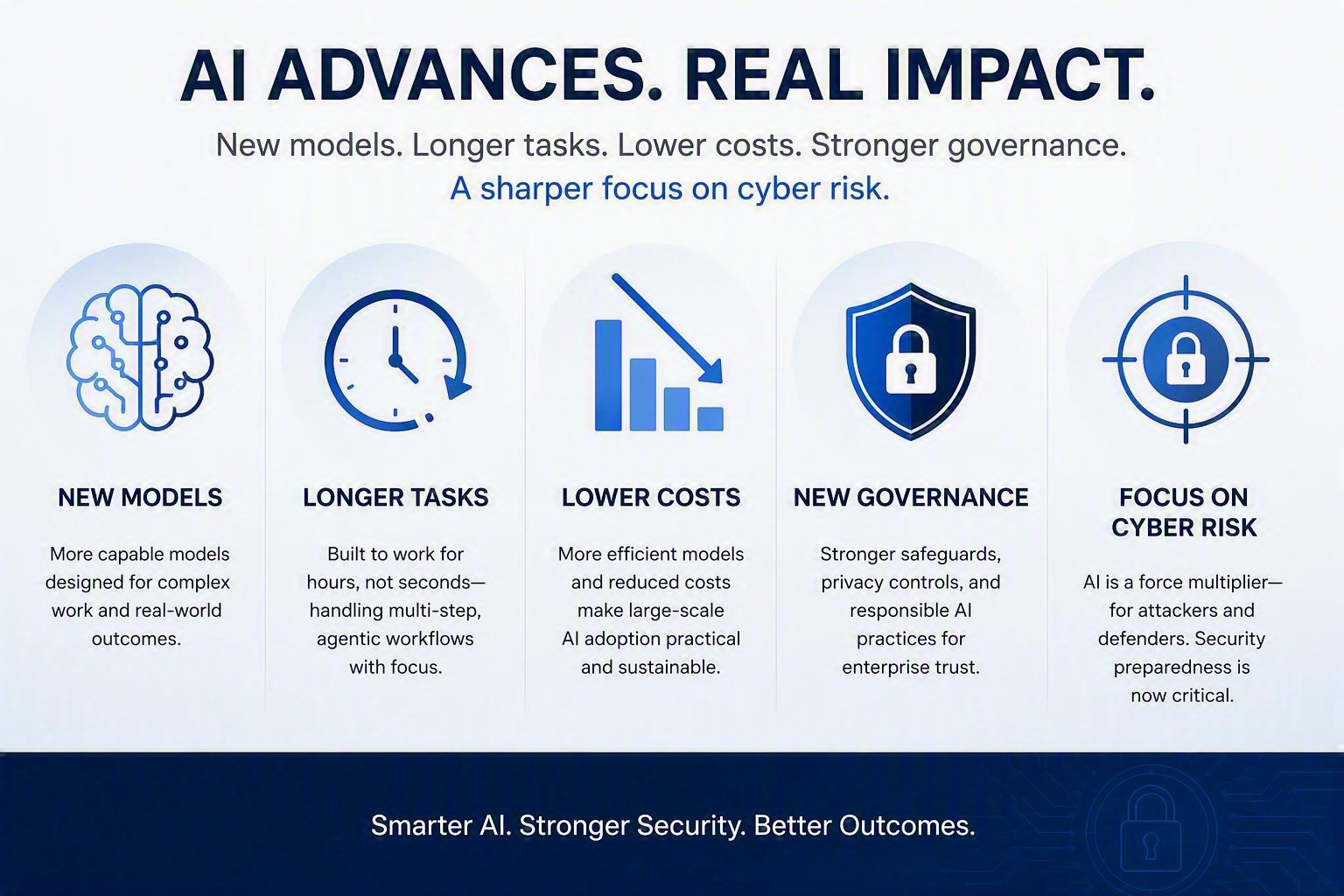

Lots of news in the AI space from Anthropic and OpenAI this week which took another leap with new models from both OpenAI and Anthropic and a new Collective Cyber Defence initiative which also hit the tech and news headlines, marking a clear shift in the industry’s approach and concerns around Cyber Security in their AI era.
In short, we are no longer just talking about new AI models, chatbots or productivity assistants – we are talking about agentic systems, autonomous decision‑making, and AI models that need cyber‑grade safety ratings and a bill that protects us from the potential dangers of increasingly sophisticated AI.
Here’s my short digest that resonated with me.
Open AI: GPT‑6 and Cyber‑Rated AI
One of the most interesting developments this week was OpenAI’s introduction of GPT‑6 Astra, a frontier‑class model designed with real‑time cyber awareness baked in. Astra isn’t just “more capable” – it’s more defensive.
Key themes emerging across industry coverage:
- Astra includes live threat‑pattern detection, meaning it can spot suspicious code, unsafe agent actions, or anomalous behaviour as it happens.
- Open AI say this is this the first OpenAI model to receive a “critical cyber rating”, part of a growing movement to score AI models for cyber risk.
- It’s built for agentic runtimes, where models don’t just respond – they act, plan, and execute.
In simple terms, OpenAI is saying that their new model (GPT-6 Astra) has become capable enough that it can potentially perform advanced cybersecurity tasks that previously required highly skilled human researchers. This is the first OpenAI model that the company has classified as “Critical” under its Preparedness Framework.
The significance is that OpenAI is effectively saying:
We have now entered an era where frontier AI models are reaching the skill level of elite cybersecurity researchers for some offensive and defensive tasks.
Build for Agents not chat!
Most interesting in the product announcements was that OpenAI are positioning GPT‑6 itself as the first AI model built natively for agents, rather than just chat. It introduces:
- Agent identity – every agent has a traceable unique persona
- Action logging – every step is observable
- Runtime governance – enterprises can monitor and constrain behaviour
- Multi‑step reasoning and planning – far beyond traditional chat models
Collective Cyber Defense – The Industry Wakes Up
OpenAI’s Collective Cyber Defense announcement is arguably the most important part of all this. Hundreds of organisations – Microsoft, Cisco, CrowdStrike, IBM, AWS, Google, Palo Alto Networks and more – have signed a public commitment calling for:
- A global surge in cyber defence
- Shared threat intelligence
- Stronger identity and access controls
- Continuous testing against frontier‑model cyber capabilities
- Responsible model access and observability
- Government‑level coordination and investment
This is not a product announcement but a strategic call to action from OpenAI and over 150 technology, cybersecurity, and enterprise organisations.
The headline message from this was:
AI-powered cyber attacks are about to become much more capable, so organisations need to accelerate defensive improvements now while defenders still have an advantage.
Anthropic: New Models Released
Alongside GPT‑6, Anthropic introduced new Claude models. This announcement is primarily about improved capability to build enterprise-grade agents that can work for longer, solve harder problems, and do it more economically.
Anthropic has released:
- Claude Fable 5.1 (general availability)
- Claude Mythos 5.1 (restricted version for approved cyber and life sciences organisations)
Importantly, Anthropic says these are the same underlying model, with different safeguard configurations.
Optimised for “Hours of Work”, Not Prompts
The key theme throughout the release is that these newer models are designed for:
- Long(er)-running coding projects
- Multi-step deep research
- Agentic workflows
- Root-cause analysis
- Complex knowledge work
Anthropic repeatedly positions Fable 5.1 as a model that can stay focused across lengthy tasks rather than simply answering questions well.
This aligns closely with where Microsoft, OpenAI and Google are heading:
Moving from assistants that answer questions to agents that complete or co-complete work.
Coding Improvements Are Getting Crazy!
Anthropic now claims significant gains in:
- Software engineering
- Bug investigation
- Root cause analysis
- Agentic coding benchmarks
- Scientific research workloads
One example Anthropic has cited was identifying the source of a long-running production issue that had reportedly evaded engineers for years.
As these tools get better, smarter and can run longer, the future of code is increasingly looking like
- Developer + AI agent
- Security analyst + AI agent
- Consultant + AI agent
Rather than AI replacing dev and domain experts entirely, but at the same point allowing people that can design to write code without actually writing a single line of code!
Lower Costs – Same Power
Anthropic also said that it has reduced cache-read costs by 75%.
For normal workloads they estimate:
- Roughly 25% lower costs
For heavy agentic workloads:
- Up to 45% lower costs
This is of course subject to usage patterns, but this matters enormously because the biggest blocker to large-scale AI agent deployment is often not capability it is cost.
Enterprise Privacy Is Becoming A Battlefield
One aspect that didn’t get much media coverage or noise was Anhropic’s new Enterprise Frontier Safeguards (EFS) model
The goal is to:
- Keep customer data within customer-controlled infrastructure
- Maintain privacy similar to zero-retention environments
- Still provide oversight and misuse protections
This is clearly targeted at highly regulated industries such as:
- Financial Services
- Healthcare
- Government
- Critical Infrastructure
Where data residency and retention concerns often slow AI adoption. For many UK enterprise customers, this is arguably more important than benchmark scores. This is something many Microsoft Copilot customers may take for granted and in many cases is one of their USPs. This is changing.
News Wrap Up
We’re entering a new phase of AI adoption. GPT‑6, Astra, Fable 5.1 and the Collective Cyber Defense initiative show that the industry finally understands the stakes. AI isn’t just a productivity tool anymore – it’s an autonomous system capable of acting, planning, and influencing the digital world.
The organisations that thrive will be the ones that treat AI like any other powerful technology: with governance, identity, observability, and security at the centre.
AI capability is accelerating – but cyber risk is accelerating faster. The winners will be the ones who secure both.
Thoughts?
Leave a Reply