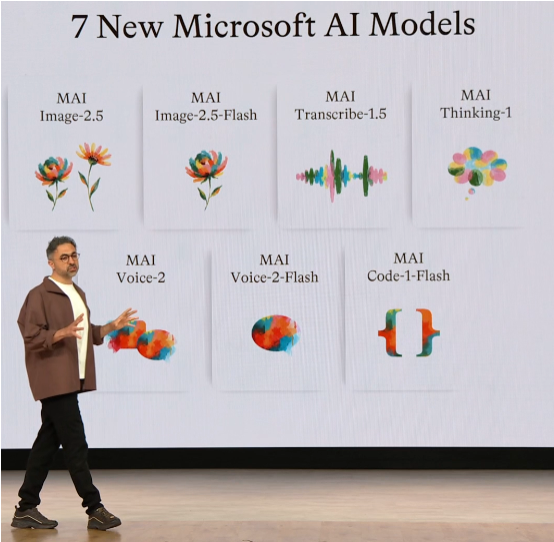

At Microsoft Build this week (June 2nd to June 4th) Microsoft dropped seven new MAI models, and it’s the clearest signal yet that they’re no longer just OpenAI’s biggest partner and a big Anthropic partner – they are (and now have) building their own frontier stack optimised from the silicon (Azure Data Center hardware to Copilot Plus PCs) to Cloud and new quantum computing chips that are optimised for and tuned for their own Microsoft AI (MAI) reasoning models.
Microsoft has entered a new phase in its AI evolution – one where it is no longer just the world’s most influential AI partner, but a full‑stack AI company with its own frontier‑class models, its own agent ecosystem, and its own quantum‑accelerated hardware.
Each of their new and updated models is designed to power the next generation of Copilot, Azure AI, GitHub, and Windows. This is the most significant expansion of Microsoft’s AI capabilities since the launch of Copilot and a clear signal that Microsoft intends to own the entire AI stack from silicon to reasoning.
The 7 new Microsoft AI Models announced at Build
So here is the quick version, followed by a deeper explanation.
Microsoft AI Models
- MAI‑Image‑2.5 – High‑fidelity image generation (live in Azure AI Foundry + Designer) and rolling out to PowerPoint Edit.
- MAI‑Image‑2.5 Flash – Ultra‑fast image generation (live in Copilot Chat)
- MAI‑Transcribe‑1.5 – 43‑language transcription (live in Azure AI Speech + Dynamics Contact Centre) – expected to come to Teams for transcription.
- MAI‑Voice‑2 – Expressive, emotional voice generation (already live in Copilot Voice + Azure AI Speech)
- MAI‑Thinking‑1 – Their new reasoning model (live Azure AI Foundry and coming to Copilot Chat interfaces)
- MAI‑Code‑1 Flash – GitHub Copilot’s new coding engine (live in Github to test)
- MAI‑Transcribe‑1 / Voice‑1 – Production‑ready models for developers
This is the biggest strategic shift since the launch of Copilot and links well to Microsoft announcement of Majorana 2 – their new quantum Chip.
Let’s look at these in more detail.
MAI-Image-2.5
Microsoft’s new flagship image generation model – built for realism, precision, and enterprise‑grade control.
- High‑fidelity image generation
- Precision editing and in‑painting abilities
- Enterprise, Brand‑safe outputs
- Strong benchmark performance – ranked higher than Google Nano Banana-2!
This will start to show up in OneDrive, PowerPoint, Microsoft Designer and of course Azure Foundry and other Copilot Tools.
MAI-Image-2.5-Flash
This is a high‑speed, low‑latency version of Image‑2.5. It brings:
- Sub‑second image generation
- Optimised for chat workflows
- Lower compute cost
We will start to see this soon in Copilot Chat Image Creation and other Core M365 places as well as of course in Azure Foundry and Copilot Studio.
MAI‑Transcribe‑1.5
This is a multilingual transcription model designed for global enterprise communication. It can currently provide
- Transcription and understanding across 43 languages
- Up to 5× faster encoding than any other model on the market (Juen 26)
- High accuracy with speaker separation
- Context‑aware transcription
We will start to see this in services such as
- Azure AI Speech
- Dynamics 365 Contact Centre
- Azure AI Foundry
- Windows Copilot Runtime (speech pipeline)
- Microsoft first party apps like Microsoft Teams.
MAI‑Voice‑2
This is Microsoft’s next‑generation speech synthesis model with emotional control. It has been in preview for a while and even existing inside “Voice expressions” feature inside Copilot Consumer. It is provides:
- Natural, expressive voice generation
- Emotional tone control
- Multi‑language support
This is currently live in
- Azure AI Speech (preview)
- Azure AI Foundry
- Copilot Voice (Web + Windows) Confirmed in the MAI announcement.
- Copilot Consumer – Voice Expressions (experimental)
MAI‑Thinking‑1
This is Microsoft’s new frontier‑class reasoning model – the most strategically important model in the MAI family as it will allow Microsoft to start using their own first party models rather than just relying on (and being at the mercy of) Open AI and Anthropic in their core product streams. This model can provide:
- ~1 trillion total parameters (Mixture‑of‑Experts)
- a 256K context window
- Multi‑step reasoning
- Planning and agent orchestration
- Built from scratch (no distillation from OpenAI or Anthropic)
It is available already in Azure AI Foundry and is expected to come to Copilot Chat (Web + Windows) as a selectable model very soon!
MAI‑Code‑1 Flash
This is a high‑performance coding model optimised for real‑time developer workflows. It will offer lower cost agentic development support and excels at:
- Fast code completion
- Strong benchmark performance against leading models including Google and Anthropic
- Being lightweight and cost‑efficient
It is already live (and currently free to try) in GitHub Copilot
MAI‑Transcribe‑1 / Voice‑1
The new earlier‑generation models are now available broadly for developers to build and test with and live across Azure AI Foundry.

Majorana 2: Quantum Foundations and Hardware Leap
Microsoft’s new topological quantum chip (Majorana 2) is now powering hybrid workloads in Azure Quantum – laying the groundwork for quantum‑accelerated AI which will be powered and optimised by their new MAI models.
The Majorana 2 quantum chip is one of the most important – and least understood parts of Microsoft’s longer term AI strategy. It brings:
- The next‑generation topological quantum chip
- Designed for stability and error‑resistant qubits
- Built for hybrid classical‑quantum AI workloads
Topological qubits are the most promising path to scalable quantum computing – and Microsoft is the only hyperscaler pursuing them at scale.
Mustafa Suleyman calls it Humanist Superintelligence – AI designed to amplify people, not replace them. He described the concept of Humanist Superintelligence as underpinning the MAI model family describing the core principals as:
- AI should amplify human capability
- Safety and alignment are foundational
- Enterprise trust is non‑negotiable
- AI should be accessible across ecosystems
This philosophy is now embedded across their Copilot, Azure AI, and Windows eco systems – Chip to Cloud.
Final Thoughts
Wow – Microsoft’s seven new MAI models represent a much-needed models’ decisive shift. Build 2026 was the moment Microsoft became a full‑stack AI company rather than an orchestrator. From reasoning to voice, from image to code, and from silicon to quantum, Microsoft now owns the layers that define modern intelligence, whilst still offering choice and partnership with other AI leading models across the globe. This is about choice, flexibility, cost control and leading first party models.
Leave a Reply