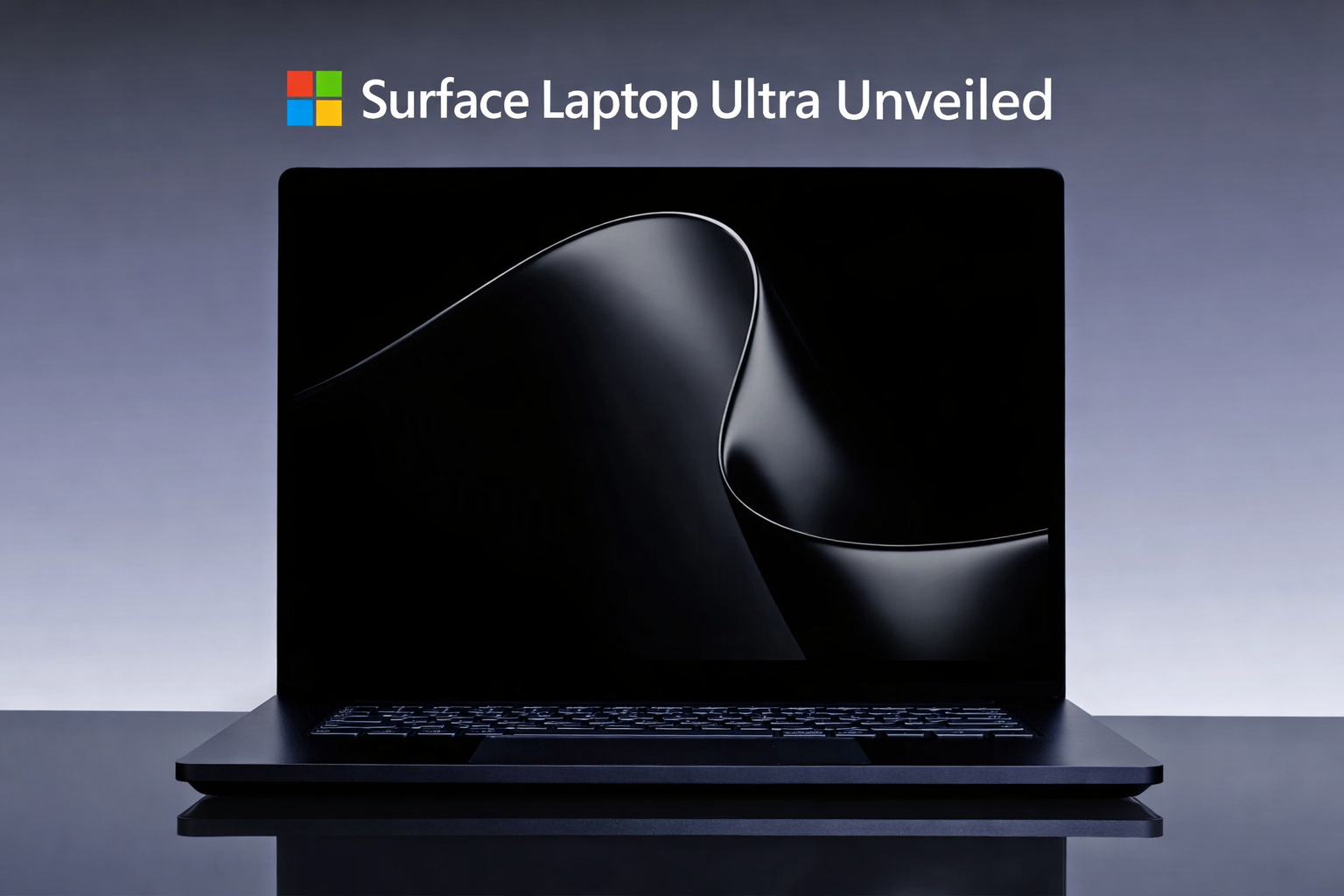

Microsoft has unveiled the Surface Laptop Ultra, its first true MacBook Pro competitor of the Apple Silicon era – and arguably the most ambitious Surface device they have built in a long time.
Complete with Microsoft Sizzle video (🔻see below 🔻), this will be available to buy from Autumn 2026, and it is the first time Microsoft has gone all‑in on a workstation‑class laptop specifically designed for creators, developers, and AI Platform builders who have outgrown traditional ultra portables and 2-in-1s but don’t want a chunky custom build desktop. It comes in a new unique colour – Platinum Nightfall which looks beautiful.
Take a look at the video – this is a power horse and build for running the most intensive, resource heavy and AI local workloads.
Surface Laptop Ultra – Built with NVIDIA from the Silicon Up
Surface Laptop Ultra is the first Surface engineered entirely around NVIDIA’s new N1X SoC, branded RTX Spark – a major architectural shift away from their mainstream Intel and Qualcomm based devices.
Microsoft describes it as “built for world makers,” and the hardware specs backs this up.
What is NVIDIA’s N1X SoC and RTX Spark?
- The N1X SoC is a cutting-edge system-on-chip designed specifically for high-performance computing and AI workloads.
- RTX Spark integrates advanced GPU cores optimised for rendering, AI model training, and complex simulations.
- This architecture combines up to 6,144 Blackwell GPU cores with up to 20 Arm CPU cores, delivering a balance of raw power and efficiency.
Key Silicon highlights:
- Up to 6,144 Blackwell GPU cores and up to 20 Arm CPU cores
- 1 petaflop of AI compute across CPU, GPU, and NPU
- Full CUDA support – a first for Surface
- Up to 128GB unified memory, dynamically shared across CPU and GPU
- Capable of running 120-billion-parameter AI models locally
Surface Laptop Ultra delivers workstation‑class performance in a chassis under 4.5 lbs (~2kg), with a dual‑fan cooling system designed to sustain heavy rendering and AI workloads without throttling.
What do these specs mean?
- Blackwell GPU cores: These are the processing units specialized for graphics and AI tasks, enabling faster rendering and AI computations.
- Petaflop of AI compute: Represents the ability to perform one quadrillion floating-point operations per second, crucial for training and running large AI models efficiently.
- CUDA support: Allows the laptop to run a wide range of AI and graphics applications optimized for NVIDIA GPUs.
- Unified memory: A shared memory pool between CPU and GPU that improves speed and efficiency for demanding tasks.
This combination means users/developers can expect best in “desktop-class” performance in a portable form factor, ideal for creators and AI professionals who need serious compute power on the go.
Peak Surface Engineering at it’s best across Display and Design
Microsoft calls this the most “considered Surface design” ever.

15‑inch Mini‑LED PixelSense Ultra Display
- 2880 × 1920 resolution at 262 PPI
- Up to 2,000 nits peak HDR brightness – the brightest display ever on a Surface
- High‑precision colour accuracy for creators
- Multi-Point Touch Screen obviously (it’s a Surface!)
Largest Haptic Trackpad on Any Surface Device Yet
Surface trackpads already rival (and often surpass) most Windows OEMs trackpads as well as Apple. With Surface Laptop Ultra they are now even bigger, more precise, and fully optimised for Windows 11’s improved haptics.
Widest Selection of Expansion Ports
Microsoft finally listened and Microsoft have added the right blend of ports power-users ask for. Surface Laptop Ultra will include
- HDMI (yes, Full HDMI support with no dongles needed)
- USB‑C
- USB‑A
- Full‑size SD card reader
- Headphone jack
- No Surface Connect Port 🙁
Why This Matters – And Why Now
For years, the MacBook Pro has dominated high‑end creator workflows thanks to Apple Silicon’s efficiency and unified memory architecture. Windows laptops (until now) have struggled to match that combination of performance, battery life, and thermal stability.
Apple has recently announced Apple Neo as a move to try to grow the lower end laptop market, which other OEM Windows Laptop makers are already fighting back on. This is Microsoft yet again innovating in the Windows eco system with Surface Laptop Ultra, something we will likely see other Windows OEMs follow up with themselves.Surface Laptop Ultra is the first Windows device that genuinely changes the equation. Microsoft, NVIDIA, and the Windows on Arm team have co‑designed a platform to:
- Bring true workstation power to a portable Arm-based Windows laptop
- Enable true local AI development without cloud dependencies
- Supports CUDA, unlocking the entire NVIDIA developer ecosystem
- Offers all‑day battery life despite the performance envelope
This update marks a significant evolution for Surface, transforming it into a powerful workstation-class device tailored for creators and AI professionals who demand exceptional performance and reliability.
In practical terms, this means users can expect a laptop that handles intensive creative workflows and AI tasks with ease, delivering reliability and speed that professionals require in demanding environments.
Microsoft has (yet again) shifted Surface from a premium ultraportable (Laptop and Pro) to a true workstation-class laptop, designed to handle the most demanding creative and AI workloads with confidence and efficiency. They had been here before (sort of) with Laptop Studio and Surface Book, but this is another league.
Why running local AI models matters
- Running AI models locally reduces reliance on cloud services, saving significant token costs associated with running cloud-based AI workloads amid the huge prices of cloud API usage.
- Local execution enhances data security and privacy by keeping sensitive information on device rather than transmitting it over the internet. Microsoft embeds security by design in Windows, including encryption of data at rest and in transit, strict access controls, and adherence to global compliance standards. This ensures AI workloads run in a trusted environment.
- It leverages the raw compute power of the device, enabling faster inference and training cycles without network latency.
Surface Laptop Ultra vs MacBook Pro
Microsoft isn’t being subtle here – this is a direct compete in the market at Apple’s high‑end configurations – a place Surface have not previously played hard.
Where it competes head‑to‑head:
- Unified memory up to 128GB (this matches / exceeding Apple’s top tiers)
- Dedicated NVIDIA Blackwell GPU vs Apple’s integrated GPU approach
- 1 PFLOP AI compute for local model execution
- Mini‑LED display with higher peak brightness of any laptop device ever made.
- Creator‑friendly ports without adapters
Windows on Arm and Microsoft’s commitment
Microsoft has made substantial progress in addressing the traditional challenges of Windows on Arm, particularly around app compatibility and performance. Through close collaboration with developers, Microsoft has accelerated the availability of native ARM64 applications, reducing reliance on emulation. The improved emulation layers now efficiently support both x86 and x64 apps, minimizing performance gaps.
The Surface Laptop Ultra leverages these advancements, delivering a user experience that is smoother and more reliable than earlier Windows on Arm devices. This progress reflects Microsoft’s long-term commitment to making Windows on Arm a mainstream platform, especially for power users and creators.
While some legacy or “niche applications” may still require evaluation for compatibility, the overall ecosystem is rapidly maturing. This makes Windows on Arm a confident choice for professionals seeking a blend of performance, battery life, and modern AI capabilities.
Surface Laptop Ultra represents a significant milestone in Windows on Arm’s evolution, offering a compelling alternative to x86-based laptops and a strong challenge to Apple’s M-series dominance.
Who Surface Laptop Ultra Is For
This device is built for people whose workloads simply don’t fit inside a “tradition” Windows laptop or 2-in-1. Like the MacBook Pro the target user for this class of device is:
- AI Builders working with “always on AI” tools like Claude Code and OpenClaw*
- 3D artists and animators
- AI researchers and model builders
- Developers with long compile cycles
- Video editors working with 8K and HDR
- Photographers needing colour accuracy and fast ingest
- Engineers running simulations or large datasets
If your workflow pushes hardware to its limits, this is the first Surface designed specifically for you.
Why they need a device like this (or MacBook Pro)
These categories/personas of professionals rely on workstation-class hardware to handle intensive tasks efficiently without bottlenecks. Devices like the Surface Laptop Ultra (or MacBook Pro) provide the necessary compute power, memory bandwidth, and optimized software ecosystems to maintain productivity and meet tight deadlines.
Why Surface Laptop Ultra should win
Where Surface Laptop Ultra offers unique advantages:
- Local AI model execution: Reduces reliance on costly cloud services, enhances data privacy, and accelerates workflows.
- NVIDIA RTX Spark SoC: Delivers superior GPU performance tailored for creators and AI workloads.
- Windows on Arm advancements: Microsoft’s commitment ensures growing app compatibility and optimised performance on the most AI optimised chipsets.
- Creator-friendly ports and display: Eliminates dongles and offers industry-leading brightness and color accuracy.
- Flexible unified memory up to 128GB: Supports large datasets and multitasking without compromise.
What about M365 Copilot users?
While many users leverage Microsoft 365 Copilot and Copilot Cowork for productivity and collaboration, these tools primarily assist with content creation, automation, and workflow management in cloud-connected environments.
The Surface Laptop Ultra targets a different use case: heavy local GPU, NPU and CPU compute for AI model training, 3D rendering, and data-intensive creative work that demands raw hardware power and minimal latency.
Whilst tools like Copilot enhance productivity through AI assistance in everyday tasks, whereas Surface Laptop Ultra empowers professionals to build, train, and run complex AI models and creative projects locally, unlocking capabilities beyond cloud-dependent solutions.
Surface Laptop Ultra Pricing and Availability
Surface Laptop Ultra looks amazing, but there are three things we don’t yet know.
- Release Date: All we know is “coming fall/autumn 2026” – I doubt we will know more until after the summer holidays!
- App compatibility: Despite Microsoft’s improvements and commitment from NVIDIA, some legacy or niche applications may not yet be fully optimized for Windows on Arm.
- Price: Nothing has been announced, but premium workstation-class hardware in a laptop typically comes at a higher cost – no details announced yet or price or SKUs.
Final Thoughts
Surface Laptop Ultra represents a pivotal moment for Microsoft’s Surface line and Windows PCs overall. It is the first Surface to truly compete with Apple’s MacBook Pro on performance, design, and professional capabilities.
This will be the most powerful Surface ever made, engineered specifically for creators and AI professionals who demand workstation-class performance in a portable form factor. Designed by the best of the Surface and Windows on Arm engineering teams.
Another factor to consider is Microsoft’s leadership in using sustainable materials, energy efficiency, device longevity, and reducing cloud dependency through local AI compute are all important factors for companies aiming to meet Environmental, Social, and Governance standards (ESG). This will likely help strengthens the overall strategic appeal of the Surface Laptop Ultra for their corporate buyers and decision-makers who prioritise responsible business practices alongside cutting-edge technology.
Could be an expensive Xmas 2026!!!
Links: https://blogs.windows.com/devices/2026/05/31/introducing-surface-laptop-ultra-made-for-world-makers/
Leave a Reply