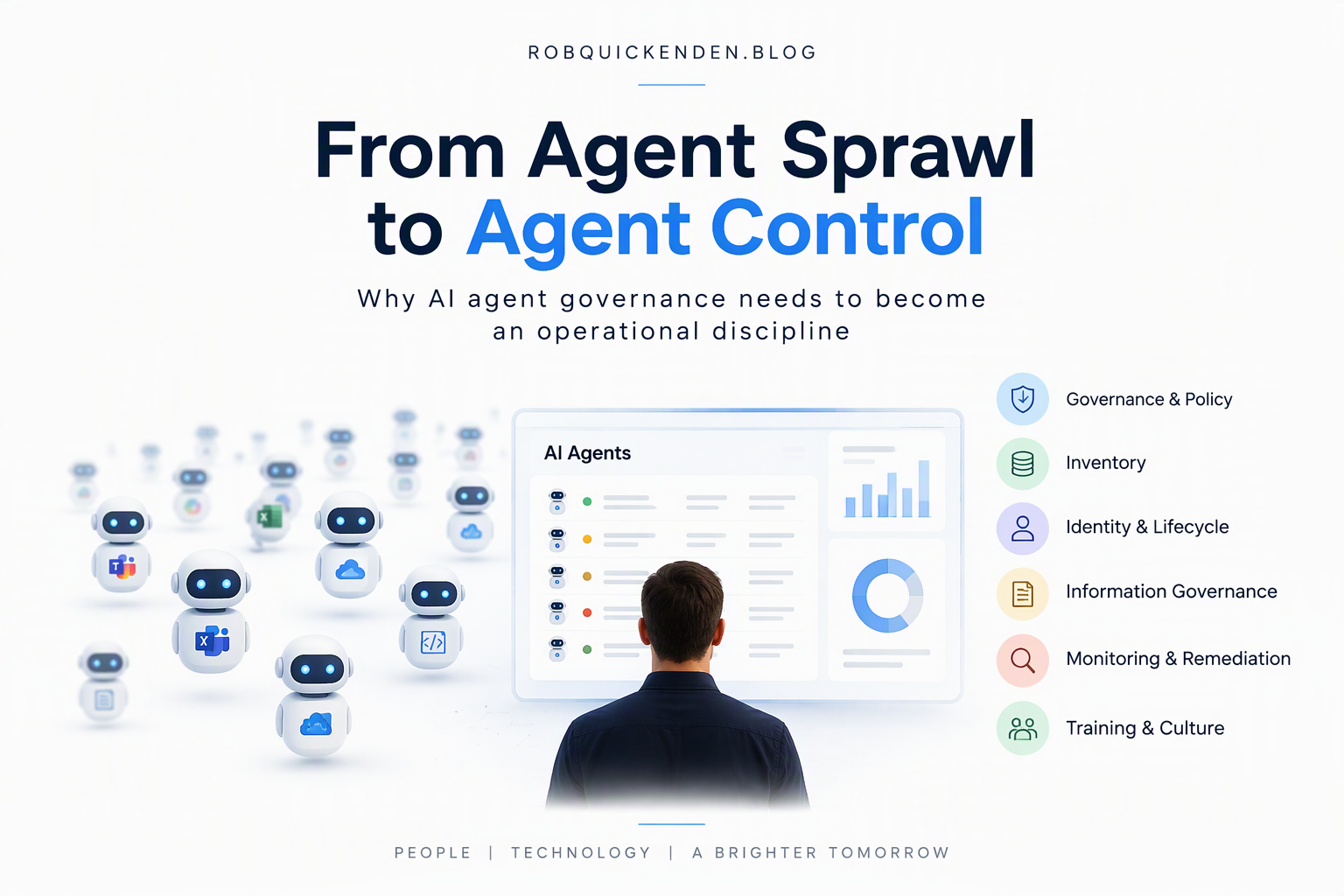

The next challenge with agentic AI will not just be about building agents, but keeping control of them once everyone starts building them. On one level, Gartner predicts that by end of 2028 the average global Fortune 500 organisation could have more than 150,000 AI agents in use, compared with fewer than 15 in 2025 yet today less than 13% of organisations “believe” they have the right AI agent governance in place. Managing AI Agent Sprawl is a real problem that needs to be tackled.
That is a pretty significant gap between the pace of adoption and our ability to govern it and this year (2026) we have seen a plethora of established vendors and new vendors coming to market with tools to help organisations understand and manage AI Agent Sprawl through AI Agent Management Platforms.
At the end of October, Gartner released the Magic Quadrant for AI Agent Management.
Gartner Magic Quadrant – AI Agent Management Platforms
Gartner defines AI agent management platforms as “centralised software platforms that manage AI agents independent of the execution environment. They unify security, governance, and FinOps controls across custom and marketplace-acquired agents.
As enterprise AI adoption scales, organisations will need these tools to manage agent deployments, ROI, and costs.

In their report, Gartner say they predict that:
- By 2029, 60% of AI agents will be managed by an agent management platform (AMP), transforming agentic AI governance into a growth driver by instilling confidence in greater levels of AI autonomy.
- By 2029, over 35% of enterprise AI run budgets will be managed by AMPs, automatically routing model calls based on verified business outcomes rather than static allocations.
As organisations build, buy and develop more agents and agentic workflows, organisations need to ensure they have
- Clear agent governance and policies
- A Central inventory of agents,
- Agent identity and lifecycle management
- Information governance, continuous monitoring and remediation,
- Responsible AI training and culture.
Importantly, this isn’t about simply locking everything down of course as doing so can push people towards shadow AI, and actually increase the risk rather than reduce it.
For me, that’s the really important point. As agents become as commonplace as apps, organisations will need to know what agents they have, who owns them, what identities and permissions they use, what data they can access, what they are doing and when they should be retired. Agent governance therefore needs to become an operational discipline, not something we bolt on afterwards.
Microsoft as a Leader in Agent Management
The below is “pasted” directly from the October 2026 Gartner Report.
Microsoft
Microsoft is a Leader in this Magic Quadrant.
Its agent management platform, Microsoft Agent 365, is available as an add-on to Microsoft 365 E5 and through Microsoft 365 E7 as a public cloud SaaS offering. It provides agent discovery, inventory, identity, life cycle management, policy administration, and security and compliance across Microsoft and third-party agent ecosystems such as Amazon Bedrock, Google Gemini Enterprise, Salesforce Agentforce, Databricks Genie, Claude Managed Agents and Oracle Generative AI Agents.
Agent 365 differentiates through its integration with Microsoft Entra, Defender, Purview, Intune, Foundry, Copilot Studio, Microsoft 365 and Azure, enabling identity-aware access controls, endpoint discovery and security telemetry. Microsoft primarily targets large and global enterprises across key sectors including financial services, healthcare, manufacturing, and the public sector, with a geographically diversified customer base.
Near-term priorities include expanding third-party policy coverage, extending cost and value management, strengthening behavioral monitoring, and using Entra Agent ID as a common governance foundation across heterogeneous agent environments.Strengths
- Microsoft ecosystem integration: Agent 365 integrates with Microsoft Entra, Defender, Purview, Intune, Foundry, Copilot Studio, Microsoft 365 and Azure. This enables organizations already invested in Microsoft technologies to apply agent identity, conditional access, data-loss prevention, threat detection and audit controls through familiar security and administrative services.
- Identity-based agent security: Entra Agent ID gives local agents, cloud-hosted agents, and SaaS-integrated agents nonhuman identities and supports delegated, application and federated authentication patterns. Agent identity and context are evaluated before access; risk is continuously assessed to enable dynamic restriction or revocation, while Microsoft’s device and network security services can discover unsanctioned agents and apply controls beyond agents running directly in Microsoft platforms.
- Scale and market responsiveness: Microsoft benefits from a substantial enterprise installed base, broad distribution capabilities and strong financial viability. It has rapidly introduced cross-platform inventory, endpoint shadow-agent discovery, life cycle governance and security capabilities.
Cautions
- Microsoft ecosystem dependency: All of Agent 365’s principal differentiators depend on the broader Microsoft security and governance portfolio, including Entra, Defender, Purview and Intune, as organizations must already have a Microsoft 365 E5 license or equivalent to purchase Agent 365. Those products must be deployed as well. Organisations that have not deployed these technologies will require additional licenses and integrations, reducing the coherence of the proposition and increasing ecosystem lock-in risk.
- Third-party agent support maturity: Agent 365 can discover agents and synchronize agent registries from other platforms (e.g., Amazon Bedrock, Google Gemini Enterprise, Salesforce Agentforce, etc.); however, native and SDK-integrated agents receive richer identity, telemetry and policy-based governance and controls. Further platform or developer integrations are also required for managing non-native and non-SDK-integrated agents.
- Cost management and vertical specialization: Agent 365’s FinOps features and third-party cost coverage are less mature than its security capabilities. Microsoft measures ROI primarily through usage, token/model costs, and execution quality rather than financial outcome tracking, and its horizontal design provides few prebuilt, industry-specific agent management workflows.
What Agent Management do you use?
Interested in feedback from my readers on what tools/apps your business is using to manage and govern agents especially if you are not on E7?
Personally, we have been working with AvePoint and also Cisco (AI Defense) the latter of which did not make the Gartner Quadrant currently. We expect many of our customers that use M365 to leverage Agent 365 but interesting to see how this evolves and how some of the cost management features and controls come into the platform.

Leave a Comment