Cisco updates contract terms in Response to Market Volatility

Cisco’s recent update to partner contract terms, prompted by rising memory prices, has caught attention across the partner and customer community. Of course any change that vendors make that has potential to impact pricing protection or order certainty will get the channel talking.

But taken in context – and with Cisco’s own commentary in mind – this looks less like a shift in philosophy and more like a pragmatic response to a market that remains anything but stable.

Market-Wide Challenge, Not a Cisco-Specific One

The backdrop here matters.

As Cisco’s global partner sales SVP Tim Coogan outlined in a note to partners, “the industry is dealing with sustained supply constraints driven largely by AI-led demand for memory and storage” . Production capacity simply hasn’t kept pace, leading to longer lead times and rising component costs across the server and infrastructure ecosystem.

This isn’t unique to Cisco. Other major vendors have already taken similar – and in some cases more aggressive steps (we have seen this and expect to see more in the devices and desktops space). Against this challenge, Cisco’s approach is arguably measured and something they need to do given the volume of hardware product lines this is likely to affect.

What did Cisco announce around pricing changes?

As Cisco announced to partners last week and the channel has loudly commented on, the key headlines were:

  • Cisco are changing partner terms and now reserve the right to cancel compute orders up to 45 days before shipment
  • Cisco also reserve the right to adjust pricing if component or manufacturing costs materially change.
  • Cisco are revising the quote validity but they have said they work work with partners to operationalise the changes and will clearly communicate the changes.

For partners like us, none of this is ideal as customers expect prices to be help subject to deal reg and partner pricing terms. As such this means partners will likely need to change their terms too.

Certainty and confidence is of course preferable, but there are some important nuances worth calling out in these annoucements.

Why are there changes happening?

One of the more overlooked aspects of Cisco’s position here is the why these changes are being made.

On Cisco’s Q2 earnings call, CEO Chuck Robbins was explicit that Cisco is leaning heavily into its supply chain scale and financial strength to secure memory supply – including advanced purchase commitments that have increased significantly year-on-year. They are also assuring partners that they will keep them up to date around pricing and supply chain challenges.

For partners, that matters a lot since it’s partners customers talk to about what is happening so important for partners to be kept up to date.

Any technology vendor that can secure supply, even at higher cost, is better positioned to fulfil customer demand than a vendor (compete) that simply freezes or cancels orders at the last minute.

According a CRN report, Cisco’s 45‑day cancellation window is actually more generous than policies being introduced by other vendors in the market. Cisco’s approach does means that partners should get:

  • Earlier visibility of potential changes impacting deals and projects.
  • More time to manage customer expectations and look at alternatives or options.
  • Greater confidence that committed orders are backed by real supply planning.

Of course from a customer perspective, the alternative to this approach is often worse.

The worst thing for an organisation is when they see poorly (or not communicated) silent price increases, delayed shipments, or last-minute order cancellations. These can erode trust far more quickly than upfront conversations about market volatility.

Cisco’s CFO Mark Patterson said that that the “we are adjusting terms to control what we can control” while staying close to market dynamics .

This transparency will hopefully gives partners the opportunity to have informed, proactive discussions with their  customers with statements backed up by the Cisco rather than fobbing them off. Something many organisations learned the hard way during the pandemic-era supply crunch with stuff cancelled, prices increased and supply chain lies.

Trust and Execution

Communication will of course be how Cisco are measured and trusted here (as will Cisco Partners).

Partners need clarity and will demand it from Cisco if it’s not given proactively, particularly around revised quote price protection periods — and they’ll need it quickly.

Parnters need to be able to meet there commitments too, so know whether a quote is valid for 45 days, 30 days or three days materially changes how customer conversations are framed by partners.

Final Thoughts

It’s not perfect, but it’s happening and expect others to follow.  In a market defined by uncertainty, pragmatism may be the most partner-friendly option available.

Will organisation change or shift vendors? Maybe. Will those others compete vendors be as open and honest with partners and customers? Who knows. Will organisations look to do more in cloud to mitigate these risks? Perhaps.

Cisco go Beyond Expectation with huge upgrade to partner incentive program at 2023 Partner Summit.


At Cisco’s 2023 Partner Summit this week, Cisco annouced a massive shakeup in their partner incentive programme. I my experience (and from the partners I work with), this makes Cisco’s incentive programme really stand out as top in class, in terms of where and how partners are rewarded.

In short, this new Partner Incentive is based-on three areas.

  • Rebates for one-time sales deals.
  • Incentives for recurring business.
  • Additional rebates for driving customer value services such as driving adoption and increasing subscription volumes (seats).

Inventives aligned to Cloud

Cisco said that they are transforming the partner program to align with its transition to more software and services-based offerings.

The new Cisco Partner Incentive programme is designed to reward partners for selling Cisco hardware, software and as-a-service solutions by aligning the rebates paid, based on total contract value, customer adoption and growth of the subscriptions they have bought. This will help ensure Cisco partners work more closely with their customers (as against one off deals) to ensure their customers buy it, use it and grow it, rather than just focusing on selling product.

This is a similar approach that longer standing cloud vendors such as Microsoft use to drive usage and adoption of their products and services.

The Cisco Partner Incentive is the biggest change we’ve made to partner incentives in more than a decade and is the capstone on the Cisco partner programme evolution started in 2020.

Marc Surplus |VP partner programs|Cisco

The new icentives will also better support their partners to acquiring new logos, for up selling additional cisco products and services and for cross selling into other accounts. Partner that offer and upsell “Cisco Powered Managed Services” will also receive increased rebates.

Skills Shortages driving Managed Service Demand

Cisco estimates that the managed services market for its products is worth $161 billion, and expects 46% of its sales to be sold as a managed service by 2027.

More and more organisations are turning to trusted Cisco Partners to look after support and maintaining their technology and help drive adoption of technologies to increase ROI and usage across their organisations.

New Specialisations to differentiate the top partners

To help partners differentiate in the market and demonstrate their expertise, Cisco is also introducing up to six new solution specialisations within the next nine months. These will cover areas such as cloud, security, collaboration, IoT, data center and enterprise networking.

Cisco is also enhancing its partner experience platform (known as PXP) with new features which include as a new sustainability estimator, that will enable partners to calculate and present their customers with environmental and cost benefits of modernising their IT hardware with the latest technology. This will made available only to environmental sustainability specialised partners.

Cisco is also introducing new Partner Advanced Support for Managed Service Providers (MSPs) along with guided access to API integrations that build on MSPs’ existing services and integrate into their operation and support services platforms such as Service Now.

New partner program starts H2 2024

The new Cisco Partner Incentive is expected to begin in the second half of 2024, and will replace the existing Value Incentive Program (VIP) and VIP Annuity.

Designed for everybody to wins

Cisco says the new incentive will provide more predictability and profitability for partners, as well as more value for customers. This is great news for partners like us (Cisilion) as it helps us drive more value for customers, while keeping prices for product and services low in an ever more competitive landscape.

Rewarding partners for growth and adoption of Cisco products helps ensure customer leverage maximum value and ROI of their investment, ensures partners continue to add value and that Cisco (hopefully) retain and grow their market share across their extensive product portfolio.

Rob Quickenden | CTO | Cisilion.

Why Cisco’s new Solution Specialisations are great for Cisco, their partners, and their customers

As tech vendors continue to modernise and revamp their partner programmes to better align with the pace of technology, changing needs of their customers, demands around hybrid work and the continual digital transformation acceleration, Cisco have recently added six new solution specialisations which aim to further build and support their partner competitiveness as well as recognise and reward partners with specific expertise and capability.

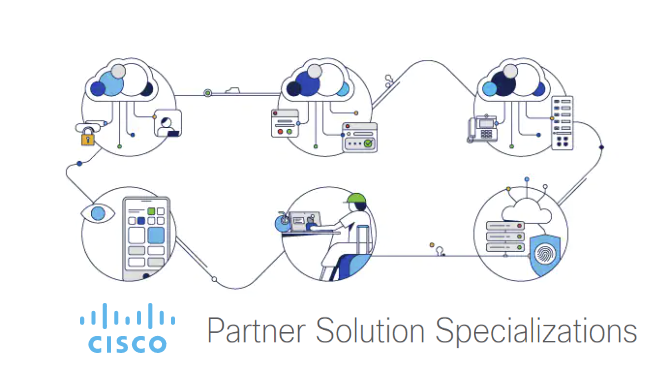
Image (c) Cisco

The six new specialisations are tied to Cisco customer priorities and represent fast-growing market opportunities for Cisco and its partners in areas where Cisco has been investing and innovating. These are heavily focussed around Hybrid Cloud and Hybrid Work and the solutions that enable these.

Cisco’s Solution Specialisations

The new solution specialisations are one of the four categories of partner specialisations available to qualified Cisco partners, like Cisilion to demonstrate their expertise to customers, including:

  • Architecture specialisations: demonstrate product expertise in specific technology areas.
  • Solution specialisations: demonstrate that a partner excels at delivering value with Cisco solutions, including cross-architectural offers prioritized by customers.
  • Cisco Powered Service specialisations: convey partner proficiency in delivering managed services and as-a-service offers.
  • Business specialisations: focused on horizontal business practices that are essential to supporting customers’ business goals.

Partners that achieve solution specialisations are recognised and rewarded based on the value delivered to customers. The requirements for each specialisation are tied to knowledge and experience, allowing partners to capitalize on their existing investments with Cisco.

The relevance of the new Solution Specialisations

Cisco say their solution specialisations are designed to “showcase partner value to customers and represent the type of solutions partners are selling today“. These specialisations (which are not simple to earn and retain), reflect how Cisco partners, like Cisilion, are using cross-architectural solutions to solve their customers’ biggest challenges (such as how to address the challenges or hybrid work) rather than just simply selling and deploying technology products. Cisco say that “the specialisations are awarded to partners that can demonstrate how they are working collaboratively with Cisco to help solve customer challenges such as balancing an organisation’s security needs with the flexibility employees want, providing the best digital experience or consistently delivering a secure user experience from anywhere.

Specialisation is ranked number one as the initial critical partner selection criterion for 74 percent of customers. By tying solution specialisations to customer buying criteria, Cisco makes it easier for customers to identify which partners to work with.

Techaisle Take: Cisco Partner Program

The six new solution specialisations

  • Full-stack Observability (FSO): Which highlights partners expertise in centralising and correlating application performance analytics across the full IT stack. This includes integrations across Cisco’s AppDynamics, Thousand Eyes, Intersight, and Secure Application. Partners with this specialisation can demonstrates expertise in prioritising actions to deliver superior customer experiences, drive revenue streams, and accelerate digital transformation for their customers.
  • Hybrid Work from Office: Which recognises partners for their skills and experience helping customers evolve traditional on-site and off-site work models, with solutions that power hybrid work, enabling people to work safely and securely from home, the office, and anywhere in between on any given day or time.
  • Secure Access Service Edge (SASE): Which highlights partners’ ability to help their customers to securely enable the growing universe of roaming users, devices, and software-as-a-service (SaaS) apps without adding complexity or reducing end-user performance.
  • Hybrid Cloud Computing: Showcases partners that provide customers with simple, secure hybrid cloud computing experiences at home, in the office, or anywhere.
  • Hybrid Cloud Networking: Recognises partners that securely and efficiently connect and manage customers’ data, workloads, and applications across data centres, edge, and multiple clouds.
  • Hybrid Cloud Software: Demonstrates expertise in managing operational complexity by helping customers streamline and unify IT operations with secure, hybrid cloud management software.

Benefits for Customers and Partners

The main benefit is that this approach takes away from an old-skool technology/product sell that was all about speeds, feeds, features, and cost, and instead encourages partners to have more meaningful “outcome-based conversation“. Cisco say this should help partners do what they do best – having a more “unified solution strategy” conversation with customers where technologies integrate and work together to provide solutions that are better than the sum of the parts.

Examples of this include the alignment between Cisco’s Webex video, calling and meeting services, the network infrastructure layer, the edge, and the Internet with integrated full stack visibility across these layers to ensure the best user experience whilst simplifying IT operations through management and support.