
TL;DR
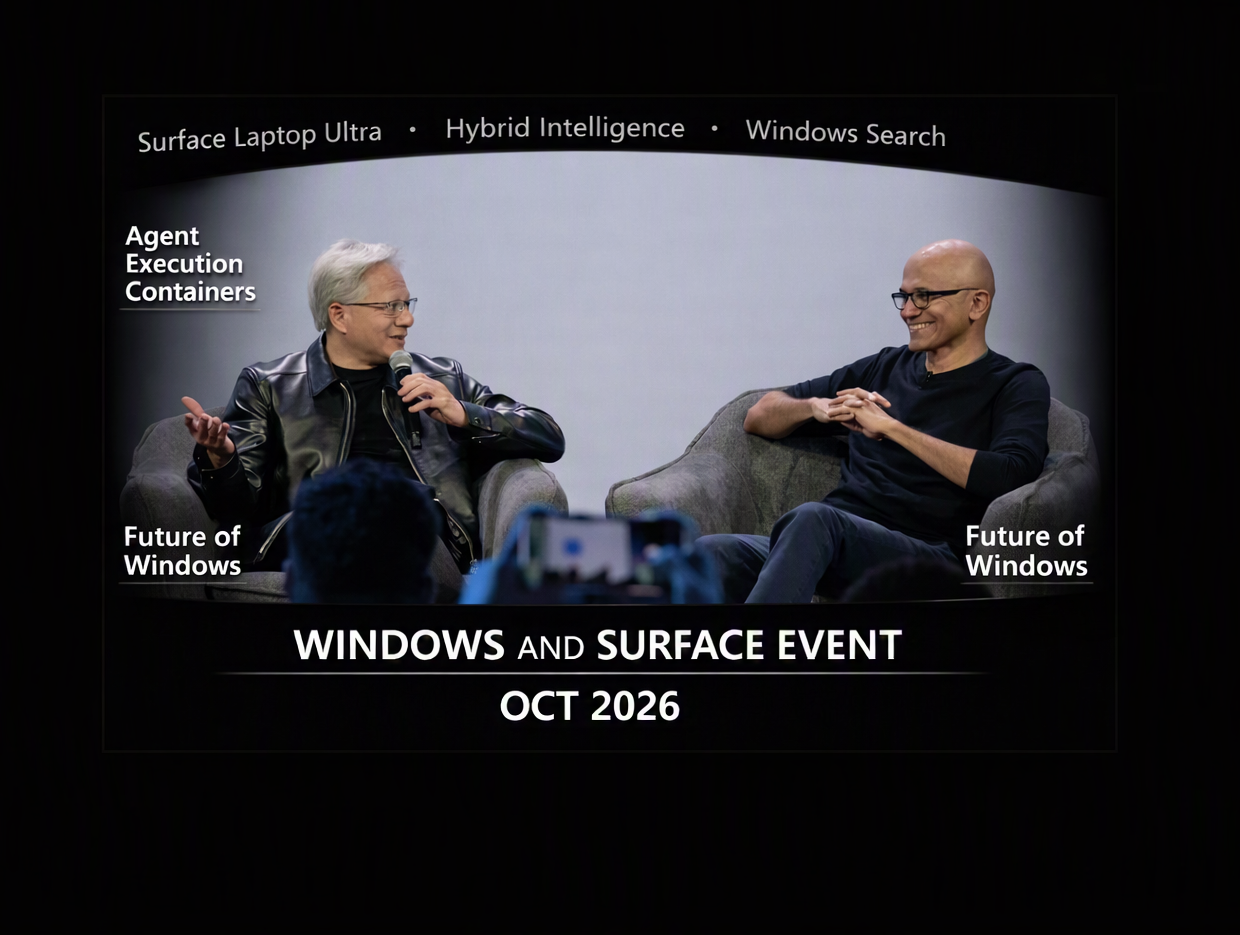
Many of us were expecting the formal availability and pricing of Microsoft’s much anticipated Surface Ultra Laptop and RTX Dev Box which was announced at Build earlier this year, but we got a lot more.
Yes, on the “Surface”, Microsoft’s Windows + Surface event looked like a hardware launch, but the real announcement was much much bigger.
This wasn’t just about new devices – with Surface Laptop Ultra and Surface RTX Dev Box being formally released with pre-orders now open 🙂

That said, the wider events theme went way beyond just the hardware – It was about Microsoft’s vision for Hybrid Intelligence:
- AI running locally on devices and in the cloud at the same time.
- Windows evolving into a platform for AI agents.
- Copilot becoming part of the operating system rather than another application.
- New security controls being built specifically for autonomous agents.
- Windows Search evolving from a search box into an action engine.
- NVIDIA and Microsoft effectively defining what an AI-first PC looks like.
Since Surface Laptop Ultra is aimed at high-end power users and developers, this even will likely be remembered less for the hardware moment and more as the point where Microsoft publicly repositioned Windows as the operating system for the AI era.
If you want to read more rather than walk through my overview, check out the official Microsoft site or watch the re-run of the live stream.
- Microsoft Announcements: news.microsoft.com
- Microsoft YouTube Launch: Windows and Surface Event Video
Windows – What Comes Next.
Every few years, a technology company hosts an event that seems fairly straightforward on the surface.
- A new device.
- A refreshed user experience.
- A few new features.
But underneath, something bigger has been in the works and at yesterday’s Microsoft Windows and Surface event this was one of those new moments. Satya referred to his memories of the 90s when x86 architecture and Win32 were announced. So what happened:
- Yes, Microsoft announced new hardware.
- Yes, there were demonstrations of new Windows experiences.
- And yes, there was plenty of discussion around Copilot and AI.
But if you step back and look at the event as a whole, this wasn’t really a Windows launch. It was Microsoft’s clearest statement, yet on what they see the future of computing looks like when AI becomes a native part of the platform.
Throughout the hour live session, Microsoft repeatedly talked about local AI, hybrid intelligence, AI agents, security boundaries, and new developer capabilities that allow intelligence to be embedded directly into the operating system.
For anyone working in technology strategy, workplace transformation, endpoint management, security, or AI adoption, that’s the story worth paying attention to.
Windows Hybrid Intelligence
For the last few years, the AI conversation has largely revolved around cloud services.
- Want intelligence on tap – you send your code requests, instructions and requirements to a secure cloud-hosted model [Copilot, Github Copilot, Codex etc).
- Need more capability? – Use a larger cloud model.
- Need more reasoning? – Ingest more cloud resources.
Microsoft described a future built around what they call Hybrid Intelligence, where workloads can move dynamically between local devices and cloud infrastructure depending on the task being performed.
Windows Hybrid intelligence is about routing AI work between local hardware and the cloud, per task
This is about having AI agents that run on your device when that makes sense and, in the cloud, when it does not, with Windows providing the security, identity and management layer around them. In Microsoft’s blog post, Building Windows for Hybrid Intelligence, they position Windows as “the place where agents live, not just a window for a chatbot”.
This matters, because it is essentially the end of “Cloud-Only” AI. Because, for years, organisations have raised valid concerns around:
- Data sovereignty
- Compliance
- Latency
- Increasing Cost (Tokenomics)
- Performance
- The need for offline AI working
Routing Decisions in Modern AI Workloads
The concept is simple: it’s about intelligent routing. Some tasks are small and private – sorting files, adjusting settings, or summarising local documents – and can run on models directly on your device. That saves cloud costs and keeps data local. Others, like extended reasoning or large‑scale coding, demand more compute power than a laptop can provide, so they’re routed to the cloud. Windows is evolving into the orchestration layer that enables software to decide where to run – and gives IT the control to manage that choice.
During the demo on the 6th October, Microsoft showed off a 137-billion-parameter coding model running locally with Airplane mode switched on
This means Copilot (by this it could be Copilot, Copilot Cowork, Code, GitHub) will be able to hand tasks to on‑device models “when cost or privacy matter more.” Jacob Andreou – Copilot’s lead, said at Build 2026, that lightweight tasks can run without touching the cloud. Satya Nadella re-enforced this by adding that “just having the model doesn’t do much,” emphasising that local AI, AI‑powered software, and AI‑native devices must converge.
Windows and Devices lead – Pavan Davuluri, who heads Windows and Devices, described the developer vision as running workloads “on‑device, in the cloud, or across both – without trade‑offs.” He’s also highlighted that Windows will continue serving human users while supporting agent workloads, focusing on foundational primitives – security, identity, governance, observability, and performance – rather than the user interface.
That is a fundamental shift in architecture.
Surface Laptop Ultra – The AI Reference Device
The headline hardware announcement was of course the much-anticipated Surface Laptop Ultra and Surface RTX Dev Box.

Surface Laptop Ultra is built around NVIDIA’s RTX Spark™ Superchip, a breakthrough platform combining an ultra‑efficient NVIDIA Grace CPU (up to 20 cores) with Blackwell RTX graphics and up to 128 GB of unified memory. Microsoft didn’t just drop this chip into an existing design – it optimised Windows for the silicon first, then engineered the entire device around it. Mechanical, thermal, acoustic, and materials engineers collaborated with industrial designers from day one to create a laptop that’s as refined as it is powerful.
The result is extraordinary. The local AI NPU delivers up to 1 petaflop of AI compute, capable of running models with more than 120 billion parameters locally — no cloud required. It’s the most powerful Surface Laptop ever built, and it shows.
This device is not intended to become everyone’s next laptop. Surface Ultra is a statement of intent “This is what an AI-first computing platform looks like.”. This reminds me of the way that early Surface devices demonstrated Microsoft’s vision for modern productivity, the Surface Laptop Ultra demonstrates Microsoft’s vision for local AI.
The specifications matter. But the message matters more.
New Windows Search
One announcement that may appear relatively small today could prove surprisingly significant. Microsoft unveiled a new Windows Search experience that includes improved language understanding, synonym matching, typo recognition, richer previews and a cleaner interface.

But the really interesting capability is that Search can now perform actions.
Instead of navigating through menus, users can simply type:
- Turn on Bluetooth
- Enable dark mode
- Adjust brightness
- Minimise windows
And Windows will perform these actions directly from Search.
The interface is increasingly becoming intent rather than navigation – that principle sits behind virtually every modern AI experience.
AI Agents Everywhere
Like it or not (Hello Terminator fans) – this part of the event was the part that caught my attention most (ok second to the new hardware).
It was Microsoft’s continued focus on AI agents and what that means in the agentic world we are driving rapidly towards.
One of the biggest concerns organisations (and people generally) have about agentic AI is “How do we govern this?”
Because once AI can do more than answer questions, the challenges change.
- An assistant helps.
- An agent acts.
- And when something can take action, it needs controls.
Microsoft addressed this directly through its announcement of Microsoft Execution Containers, designed to provide secure, controlled operating environments for AI agents based around containment, identity and manageability.

For me, this was one of the most important moments of the event.
This enables us to really start thinking about AI agents more like digital employees. To do this they need:
- An owner
- Their own Identity
- Their own Permissions (different to the user that built or runs the agent)
- Monitoring
- Security controls
- Lifecycle management
Microsoft is building exactly that kind of operational framework not only into their Agent 365 framework in Microsoft 365 but into the Windows Operating System itself.
If AI agents become commonplace, these security capabilities may ultimately prove more important than any hardware announcement.
Copilot as part of the OS
Yes – there was upraor about AI tools like Recall when Copilot PCs were launched back in 2024, but AI is part of the operating system these days – Apple, Google, Samsung, even your TV –
So yes, the other theme running throughout the event was the deeper integration of Copilot into Windows.
Microsoft demonstrated scenarios where Copilot can work with local files, perform actions and leverage both local and cloud intelligence. This is different, because historically, Copilot has often felt like an application sitting alongside Windows.
Microsoft is positioning Copilot as an intelligence layer that sits across the operating system itself. That’s a subtle but important distinction. If Microsoft succeeds in this vision and execution of that vision, then Windows become less about launching software and more about achieving goals.
What Technology Leaders Should Take From This
I speak to lots of technology leaders who will often ask “Hey Rob, what did you make of the announcements?”.
Rather than focusing solely on the announcements themselves, I think there are three bigger questions worth considering.
1. Is Your Endpoint Strategy Ready For Local AI?
Most organisations still think about AI primarily as a cloud service. Microsoft clearly does not. As AI workloads move closer to the endpoint, device strategy will become increasingly important.
We need to consider AI costs. We have three options now – Cloud Models, Models running on our own DC hardware and models running on devices. Seamlessly, together and based on demand, need, sovereignty, security and whether we are online or not!
2. Are You Preparing To Govern AI Agents?
The conversation is quickly moving from experimentation to operation. If agents gain access to systems, data and processes, organisations need governance, ownership and security frameworks in place.
We need controls at every later – the network, the cloud, the agent frame but now we can look at the hardware – AI native OS means AI native security controls. And as we move towards the post quantum world too this becomes even more critical.
3. Are Your Apps and your AI Tools Built For Hybrid Intelligence?
Increasingly, future applications are likely to combine:
- Local AI
- Cloud AI
- Traditional software
- Autonomous agents
That architectural shift will impact everything from application design to infrastructure planning. This needs to be dynamic, controllable and auditable.
My Summary Takeaways
- The Surface Laptop Ultra is resetting the Standard again (Surface First and Best).
- I whish I had bought more shares in NVIDIA and Microsoft.
- Windows Search redesign will probably become the most visible change for everyday users.
- Microsoft is re-inventing Windows – from not simply an operating system, not simply a productivity platform, but the foundation for hybrid intelligence where people, applications and AI agents all operate together.
Microsoft has now made their direction very clear – The future Windows PC isn’t just a computer – it’s becoming an active participant in the work being done, and that should be on every technology leader’s radar.
Sources and Read More
Official Microsoft Blogs
- Windows and Surface October 2026 News Hub [news.microsoft.com]
- Windows Insider Blog: New Windows Search Experience [blogs.windows.com]
Leave a Reply